
Famous sights nearby
1
Picked from Tokyo's official visitor guide — a short walk or direct exit from this stop.
Zojoji増上寺
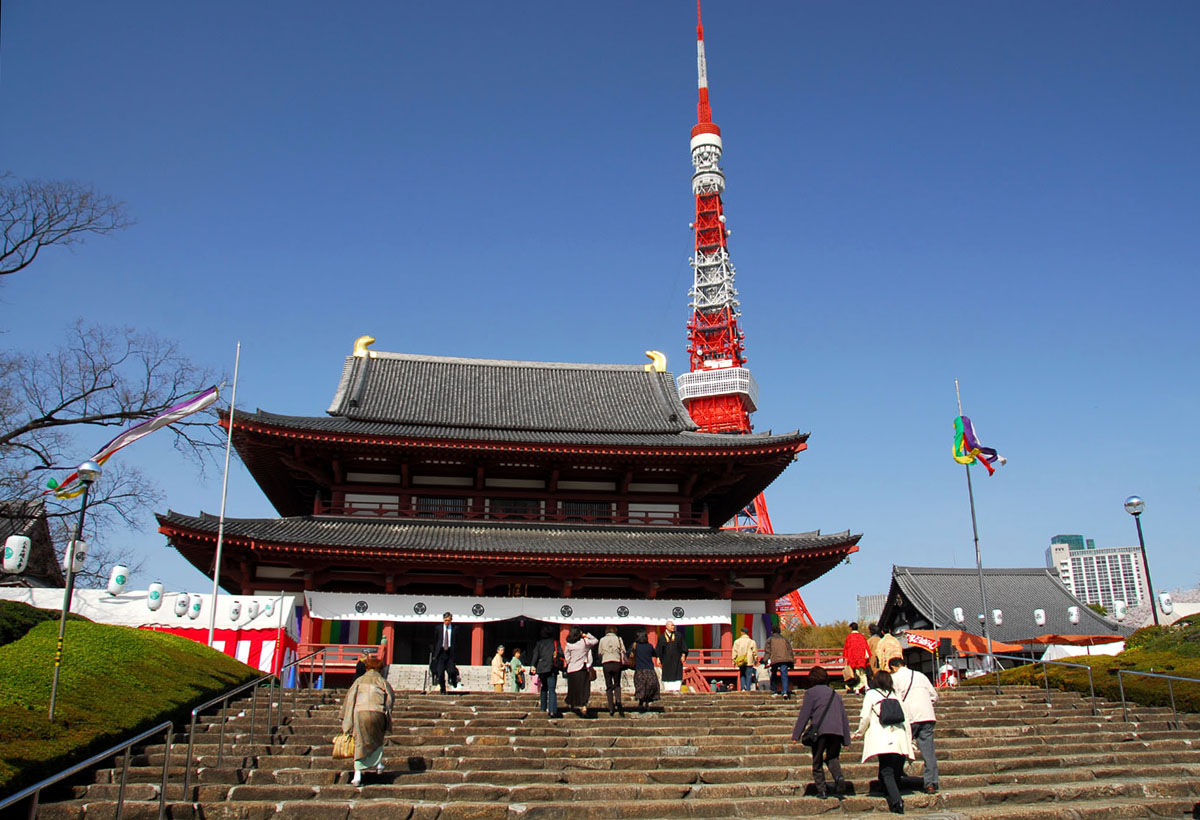
The Tokugawa family temple, its great gate of 1622 framed by Tokyo Tower behind.
≈8 min walkIwaida Street, Shibakōen 4, Parc de Shiba, MinatoSee on map →
On this line
The number on the sign, and the stops either side.
- I06
Worth a stop nearby
Featured stops a few stations from here — same train, no change.
Exits
Street exits by their posted numbers. Marked exits have a step-free entrance.
- A1
- A2step-free
- A3
- A4
- A5
- A6
Step-free access
IMita LineIsland platform
Step-free routeElevatorEscalatorAccessible toilet
City buses
Toei buses from stops a short walk away. The code on each chip is what the front of the bus shows.
Onarimon御成門~80 m
- 橋86→ Meguro Sta.
- 橋86→ Shimbashi Sta.
- 浜95→ Shinagawa Sta. Kōnanguchi (Kōnan Exit)
- 浜95→ Tokyo Tower
Flat ¥210 a ride in the 23 wards — board at the front, pay as you get on, IC card or cash.
Three or more rides in a day? The ¥500 one-day Toei bus pass pays for itself — sold on board.
First and last train
Departures from this station. A time after midnight belongs to the night before — 00:20 means tonight, not tomorrow morning.
I-06Mita Line
Northboundtoward Nishi-takashimadairalast train ends at Takashimadaira
Every day05:06–00:06
Southboundtoward Megurolast train ends at Shirokane-takanawa
Every day05:13–00:26
Zojoji Temple, in the government's words
Quoted verbatim from the Japan Tourism Agency's commentary database. None of it is ours, and none of it has been edited — the licence asks that it not be. Written in 2020.
Over the centuries, Zojoji has played an important role in Japanese history. The temple was founded in 1393, when Edo (now Tokyo) was still a small village, situated just southwest of where Edo Castle was built (now the imperial palace). In 1590 the feudal lord Tokugawa Ieyasu (1543–1616) was relocated to Edo. Ieyasu would become the founder of the Tokugawa shogunate, which ruled Japan from 1603 until 1867, and his castle would become the military capital.
Read the rest — 5 more paragraphs
Over a breakfast prepared by the chief priest, Ieyasu announced that Zojoji would become the Tokugawa family’s official temple, and the temple’s fortunes would thereafter be linked to those of the shogunate.
In 1598 Zojoji was relocated to its present location, where, under Ieyasu’s patronage, it became increasingly powerful and prosperous. Ieyasu’s funeral was held at Zojoji in 1616, and though he was buried elsewhere, the family continued supporting the temple. Six generations of shoguns were buried in elaborate mausoleums on the temple grounds, along with other members of their families.
Zojoji is the main Jodo sect temple for eastern Japan, making it second only to the sect’s head temple of Chion-in in Kyoto. At its peak, the temple was unrivaled in size in eastern Japan: the temple grounds covered more than 82 hectares, with 48 subtemples, and 3,000 priests in training and administration. The elaborate architecture of Zojoji’s gates, halls, and mausoleums were outstanding examples of the skills of Edo artisans.
After the end of the Tokugawa shogunate in 1867, the temple’s fortunes suffered from the anti-Buddhist movement of the 1870s. Many of the buildings were destroyed by fires, and some of the grounds were converted to parks. The greatest disaster in the temple’s history, however, was the aerial bombing of Tokyo in 1945, which left few of the temple’s important landmarks standing.
Today, a number of structures have been faithfully rebuilt or restored, though the temple grounds have shrunk to around one-fifteenth its peak size. Zojoji remains an influential training center and place of worship for the Jodo sect of Buddhism, as well as a popular site for visitors from all over the world.
This English-language text was created by the Japan Tourism Agency.
Not here yet
Which car to board still isn't here — it exists as posters on the platform and in no open dataset at all. Live service status covers the four Toei lines only, on their line pages: Tokyo Metro's realtime feed is licensed in a way this site can't carry.